
B is for Leon Belous

B is for Leon Belous, an unsung hero of the reproductive rights movement. He was the physician at the center of a crucial 1969 legal case in California that laid a foundation for Roe v. Wade.
Belous was born in Kyiv in 1904 and emigrated to the US with his family five years later. He graduated from the University of Illinois medical school in 1927 and then went to Vienna to study with none other than Sigmund Freud. During World War II he served in the US Navy as a medical corpsman.
Belous practiced in Los Angeles, rising to become chair of OB GYN at the Cedars of Lebanon Hospital. By the early 1960s, he had become an outspoken critic of abortion law. He wrote editorials, and we can still listen to his appearance on a 1963 radio program.
In the broadcast, Belous describes his very first abortion death, 32 years earlier. She was a 24-year-old married woman with 3 kids and an alcoholic husband. He performed surgery to repair damage from a bad abortion, but this was before antibiotics, and she died of septicemia a month later.
It took a lot of courage to speak out about abortion in the 1960s; newspapers might not even put the word in a headline. Closer to home, when his own daughter had become pregnant while a college student, Belous supported her illegal abortion.
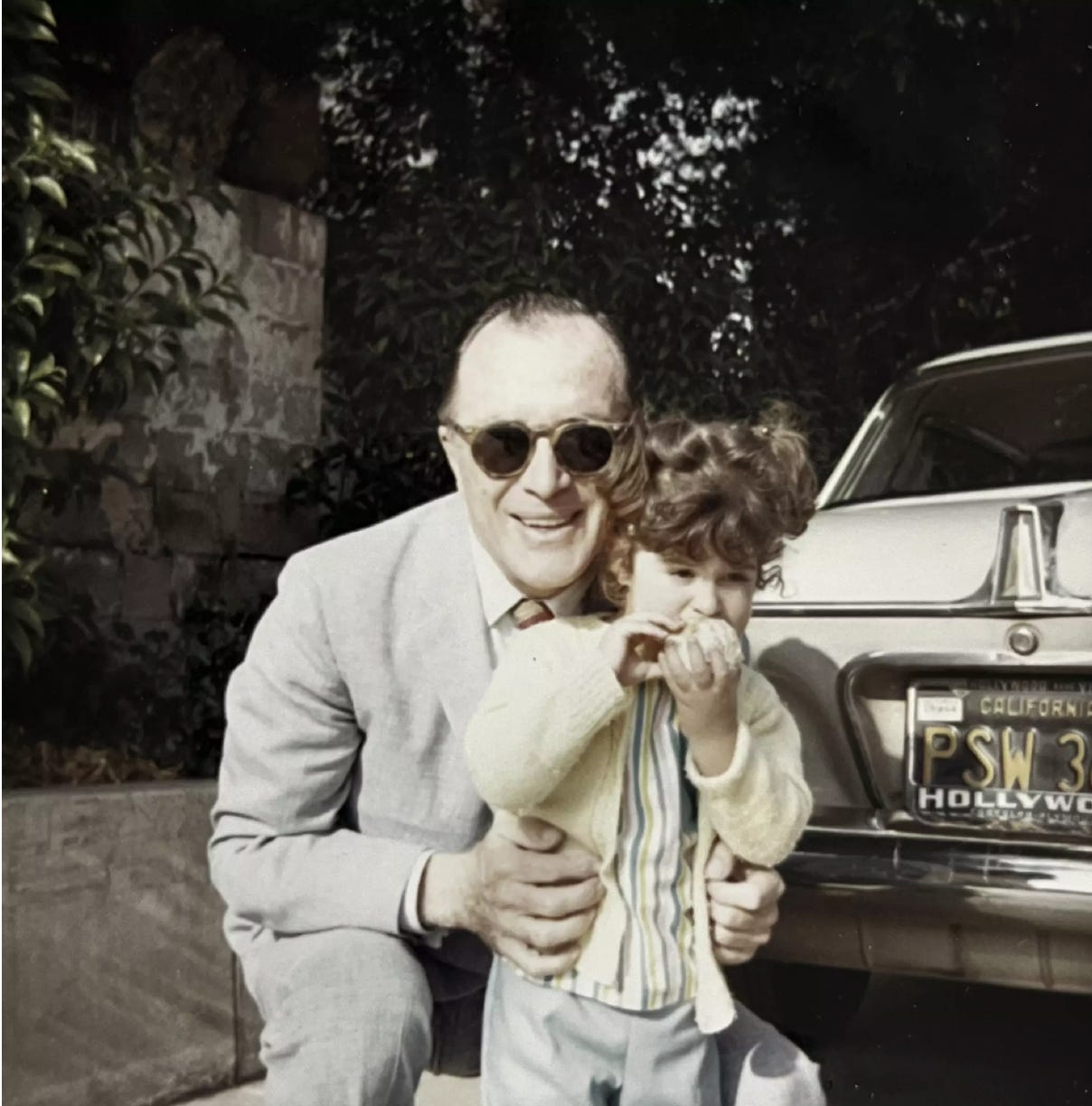
Leon Belous with a grandaughter in 1965.
When Cheryl Bryant got pregnant in 1966, she was working her way through college, preparing to be a teacher. Her boyfriend was studying to be a school psychologist. “We were poor as church mice” she recalled. And she had already borne a child in high school whom she was supporting.
She heard Belous talking about abortion-law reform on television, but when she saw him, he was adamant. He did not do abortions. She replied that she was going to Tijuana, a hotbed of illegal abortion provision. Belous had seen the disastrous results of such abortions and gone there himself to investigate. He found a very skilled provider, Dr. Karl Lairtus, who then moved to Chula Vista. He sent Bryant to Lairtus.
After the abortion, Lairtus’s apartment was raided by the police, and Belous was arrested for referring Bryant. In court, he initially pleaded guilty and paid a $5000 fine. Backed by the ACLU, he appealed the case.
In the appeal, the California Supreme Court declared the state’s 1850 abortion law unconstitutional because it was too vague. Abortion was, in effect, legalized. The court also invoked the right to privacy, creating a crucial precedent for Roe v. Wade four years later.
Decades later, Belous recalled that he had chosen OB GYN as his specialty because he felt that was where he could do the most good. Little could he have imagined what he would accomplish.
Want to know more?
Britny Mejia, “Her Illegal Abortion Paved the Way for Roe. 56 Years Later She Shares Her Story”, Los Angeles Times, June 24, 2022.
Planned Parenthood of Arizona, “Before Roe v. Wade: The 50th Anniversary of a Landmark California Case” Sept. 3, 2019.
Even more? Read my book!
Image credit: This British sampler was completed in 1903. https://www.metmuseum.org/art/collection/search/228444
Disclaimer: Today I’d refer to pregnant “people,” but in the historical times that I write about, pregnancy was a female thing, and ideas about abortion were strongly shaped by gender politics.